
The Magic of Halo Fibers


Welcome back to Summer Yarn School! We have just two lessons to go before we wrap up our summer journey together.
Over the past nine weeks, we've talked about yarn weights, spinning methods, twist, ply structure, colorways, and choosing yarn with intention. This week, we're exploring something that can completely transform your knitting even when you don't change the pattern at all.
Have you ever admired a sweater or shawl that looked impossibly soft? Maybe it seemed to glow, almost as if there was a gentle cloud floating around the stitches.
Chances are, a halo fiber was part of the recipe.
Over the past several years, mohair and suri alpaca have become incredibly popular with knitters and designers alike. Whether they're knit on their own or held together with another yarn, these fibers can completely change the look, feel, warmth, and personality of your finished fabric.
Let's explore why.
WHAT IS A HALO FIBER?
A halo fiber is exactly what it sounds like.
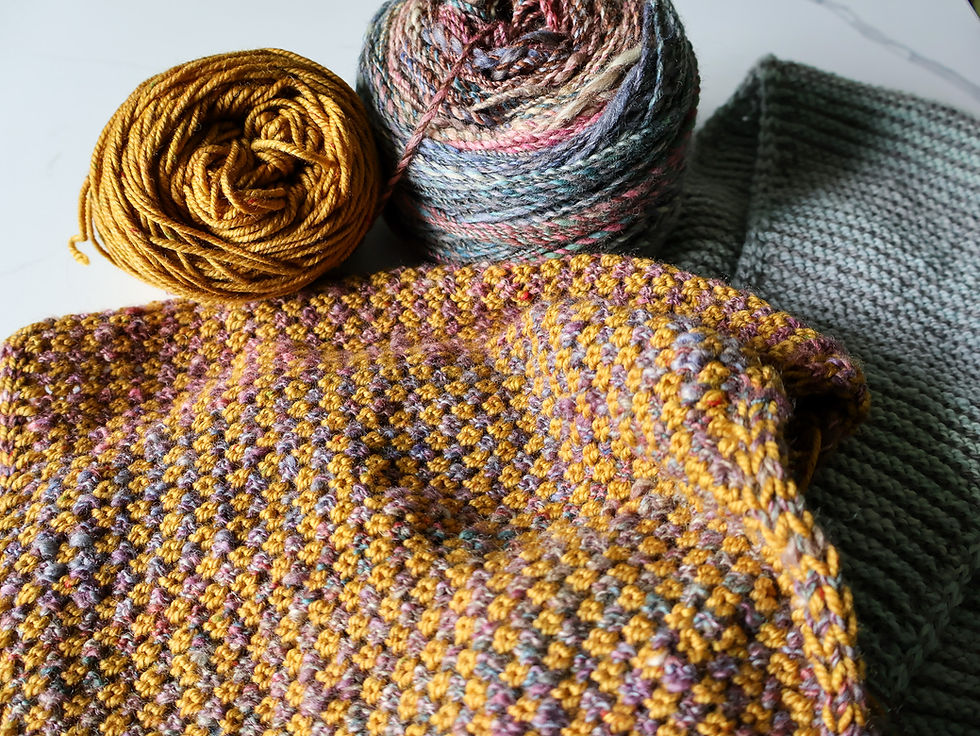
Instead of every fiber staying tucked neatly inside the strand, some of the longer fibers extend beyond the yarn itself, creating a soft, fuzzy "halo" around the knitted fabric.
That halo does more than make a project look cozy. It softens stitch edges, diffuses color, adds warmth, changes drape, and creates an entirely different knitting experience.
It's one of those magical yarn characteristics that's difficult to appreciate until you see two swatches side by side.
WHY HAVE HALO FIBERS BECOME SO POPULAR?
Halo fibers have become a favorite because they add something difficult to achieve with traditional yarns alone.
They can make a fabric feel:
Softer
Lighter
Airier
More luxurious
Surprisingly warm
One of my favorite things about halo fibers is that they allow you to create fabrics that feel substantial without feeling heavy. That's why you'll often see designers pair a strand of fingering-weight yarn with mohair or suri instead of simply using a heavier yarn.
MOHAIR VS SURI ALPACA
Although they're often used in similar ways, mohair and suri aren't identical.
Each creates its own unique fabric.
MOHAIR
Mohair comes from the Angora goat.
It's known for being:
Lightweight
Strong
Airy
Lustrous
Resilient
Mohair produces a beautiful, visible halo and often gives fabric a little more structure while still feeling wonderfully light. If you've admired sweaters that seem to float around the body, chances are you've seen mohair at work.
SURI ALPACA
Suri alpaca comes from one of the two breeds of alpaca.
Compared to mohair, suri is often:
Silkier
Softer
More fluid
Slightly denser
Less prickly for some knitters
Many knitters who find mohair irritating against their skin discover that they love knitting and wearing suri instead. Its halo is often softer and more fluid, creating beautiful drape.
Neither fiber is better. They simply create different fabrics.
WHY HOLD TWO YARNS TOGETHER?
One of my favorite things about knitting is that we're not limited to a single strand of yarn. Holding two yarns together opens an entirely new world of creative possibilities.
You can:
Add warmth without adding bulk
Increase softness
Create a gentle halo
Blend colors
Add depth and richness
Completely change the fabric without changing the pattern
Think of it like layering clothing. A lightweight sweater and a jacket together create something entirely different than either piece on its own. Yarn behaves much the same way.
WHAT ACTUALLY CHANGES?
When you pair a halo fiber with another yarn, several things begin to happen.
The finished fabric often becomes:
Softer
Warmer
More cohesive
More forgiving
More visually blended
The halo gently fills the tiny spaces between stitches, creating a fabric that feels light while trapping warmth surprisingly well. It can also soften color transitions, making tonal and hand-dyed yarns appear even richer.
HALO DOESN'T JUST CHANGE THE FABRIC...IT CHANGES THE MOOD
One of my favorite things about halo fibers is that they change the feeling of a project.
A simple stockinette sweater suddenly feels romantic. A shawl becomes ethereal. Even the simplest stitches seem softer and more inviting.
That's why you'll often see designers pair halo fibers with uncomplicated stitch patterns.
The fabric itself becomes the design element.
DO HALO FIBERS HIDE STITCH PATTERNS?
At times. Because the halo softens the edges of individual stitches, intricate cables, highly textured stitches, and delicate lace may lose some of their crisp definition.
That doesn't mean halo fibers can't be used with texture, it simply means the texture becomes softer and more subtle.
If your goal is bold stitch definition, you may prefer a smooth yarn without halo. If your goal is softness, atmosphere, and beautiful drape, halo fibers can be absolutely magical.
IS HALO RIGHT FOR EVERY PROJECT?
Not necessarily. Like everything we've explored throughout Summer Yarn School, the answer comes back to one question: What kind of fabric do I want to create?
If you're knitting:
A cabled sweater→ A smooth yarn may showcase every stitch.
An airy shawl→ Halo fibers can create incredible softness and movement.
A cozy winter cardigan→ Mohair or suri may provide warmth without unnecessary weight.
There isn't a right answer. There is only the fabric you're hoping to create.
FROM MY KNITTING BASKET
One of my favorite ways to use halo fibers is by holding a strand of fingering or DK weight yarn together with either mohair or suri.
It's amazing how much that second strand changes the finished project.
The sweater becomes lighter. The colors gain depth. The fabric feels softer.
Even familiar patterns suddenly feel brand new. It's one of the easiest ways I've found to completely transform a knitting project. And every time, I'm always "wowing" as I work through It.
TRY THIS
If you've never worked with halo fibers before, knit two small swatches.
Swatch 1: Your main yarn by itself.
Swatch 2: The same yarn held together with mohair or suri.
Block them. Hold them. Touch them.
You'll learn more from those two little swatches than any article can teach.
THE TAKEAWAY
Halo fibers aren't simply "fluffy yarn." They're another design tool.
Understanding when and why to use them gives you even more creative freedom as a knitter.
The next time you're planning a project, don't just think about yarn weight or fiber content. Think about the fabric you want to wear. Sometimes all it takes is one extra strand to completely transform your knitting.

Until next week....
Cheers & Stitches,
Crystal

Comments