
Understanding Hand-Dyed Yarns


Welcome back to Summer Yarn School! Hard to believe it's Week 9 (3 more to go!) already.
Over the past several weeks, we've explored yarn weights, spinning methods, ply structure, twist, and how color influences the appearance of our knitting.
This week, I'd like to take that conversation one step further.
Have you ever fallen in love with a skein of hand-dyed yarn only to cast on and think, "This isn't quite what I expected?"
Maybe those beautiful cables disappeared into the colors. Maybe your lace felt too busy. Or perhaps a simple stockinette sweater suddenly became stunning because the yarn did all the work.
More often than not, the difference isn't the pattern ... it's the colorway!
As a hand dyer, one of the questions I'm asked most often is: "What's the difference between tonal, semi-solid, speckled, and variegated yarn?"
The answer goes far beyond how a skein looks in your hand.
Each colorway creates a different knitting experience, highlights different design elements, and tells a different story once thousands of stitches come together.
Understanding those differences will help you choose yarns that truly bring your projects to life.
EVERY SKEIN TELLS A STORY
One of my favorite things about hand-dyed yarn is that no two skeins are ever exactly alike.
Even within the same colorway you'll find subtle shifts, gentle variations, and little surprises that make every finished project uniquely yours. That's part of the beauty of hand-dyed yarn, it has personality.
The real magic happens when those colors transform from a twisted skein into knitted fabric.
Learning how each style of colorway behaves gives you another tool for choosing yarn with confidence.
TONAL COLORWAYS

A tonal yarn is dyed using one primary color with gentle shifts in depth and intensity.
Think of it as one beautiful color dancing with light and shadow. Because those color changes are subtle, your eye naturally focuses on the stitches themselves.
Imagine spending weeks knitting intricate cables or delicate lace. A tonal yarn allows every twist, crossing, and stitch to catch the light without competing for attention.
Tonal yarns are wonderful for:
Sweaters
Cables
Lace
Texture
Colorwork
If you want intricate knitting details to shine, tonal yarns are often an excellent choice.
SEMI-SOLID COLORWAYS

Semi-solid yarns introduce just a little more movement.
You'll notice soft variations throughout the skein that give the finished fabric richness and depth without overwhelming the stitch pattern.
I often reach for semi-solids when I want a sweater or shawl to feel visually interesting while still allowing the stitches to remain the focus. They're incredibly versatile and tend to become some of the hardest-working yarns in my stash because they pair beautifully with almost every style of project.
SPECKLED COLORWAYS

Speckled yarns are pure fun. Small bursts of contrasting colors appear throughout the skein, creating delightful little surprises as you knit.
I like to think of speckles as confetti sprinkled across your fabric. One of the things I love most is that no two projects ever look exactly alike. Every stitch reveals another unexpected pop of color.
Speckles work beautifully with:
Stockinette
Simple textures
Shawls
Accessories
Socks
If your stitch pattern is highly textured or intricate, however, those playful speckles may begin competing for attention. Sometimes simple really is spectacular.
VARIEGATED COLORWAYS

Variegated yarns feature longer transitions between multiple colors.
Instead of subtle shifts, the colors become an active part of the design.
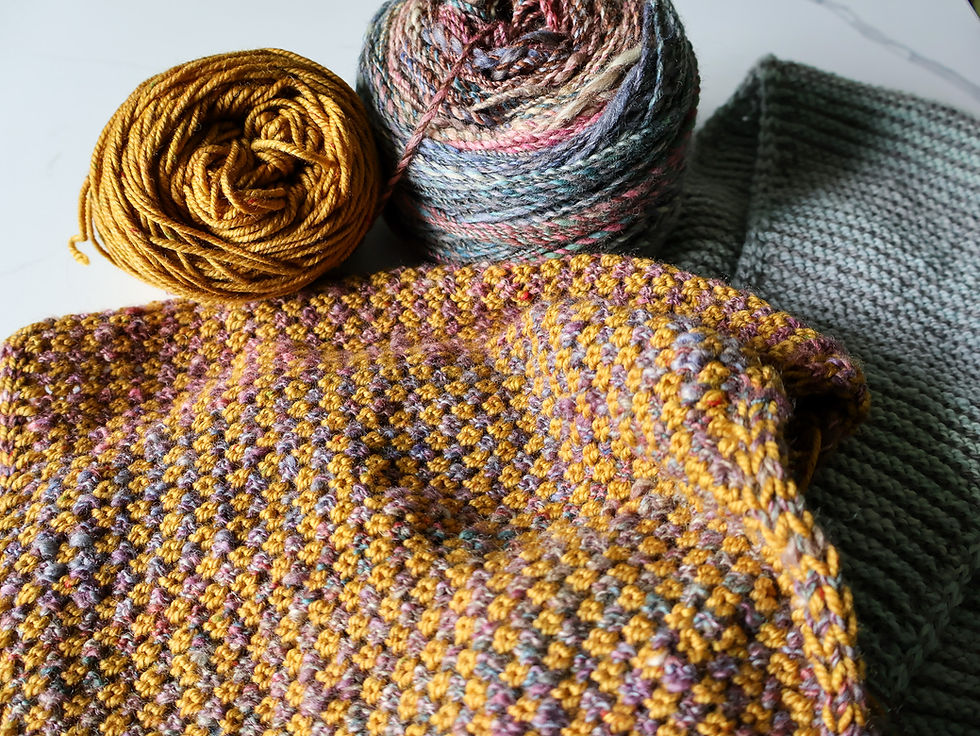
Watching a variegated skein unfold across your needles can feel almost magical. Every few rows reveal something new, making even the simplest knitting endlessly entertaining.
Variegated yarns can produce stunning results in:
Simple shawls
Socks
Stockinette garments
Sometimes the yarn itself becomes the design element.
WHAT HAPPENS WHEN THE YARN AND PATTERN COMPETE?
One of the biggest lessons I've learned as both a designer and a dyer is this: Not every beautiful yarn belongs with every beautiful pattern.
Imagine pairing a highly variegated yarn with intricate cables or complex lace. Neither one is wrong; but instead of highlighting each other, they may both become difficult to see.
Now picture that same yarn in a simple stockinette sweater. Suddenly those flowing colors become the centerpiece. The opposite is true, too. A richly textured sweater knit in a tonal or semi-solid yarn allows every stitch pattern to shine.
There are no knitting police. If you love a particular combination, knit it!
But understanding how different colorways behave allows you to make those choices intentionally.
CHOOSING THE RIGHT PATTERN
One of the best pieces of advice I can offer is this: Ask yourself "What do I want people to notice first?"
If you've spent weeks knitting intricate cables, lace, or textured stitches, choose a yarn that lets those details shine.
If you've fallen in love with an expressive hand-dyed skein, consider pairing it with a simpler pattern that allows the yarn to tell the story.
Neither approach is right or wrong. It's simply about deciding what you want to celebrate.
A QUICK GUIDE
Colorway | Best For |
Tonal | Cables, lace, texture, garments |
Semi-Solid | Everyday sweaters, shawls, accessories |
Speckled | Simple textures, stockinette, socks |
Variegated | Stockinette, simple shawls, relaxing knits |
Of course, these aren't rules. They're simply starting points for experimenting with color.
Some of the most beautiful projects come from breaking the "rules."
FROM MY DYE STUDIO
When I'm creating a new colorway, I'm not just thinking about how beautiful it looks hanging on the drying rack. I'm imagining how it's going to behave once it's knit.
Will the tonal shifts highlight cables? Will the speckles spread evenly? Will the colors create gentle movement or bold contrast?
Every colorway I create is designed with the finished fabric in mind, because that's where the real magic happens.
TRY THIS
The next time you bring home a new skein of hand-dyed yarn, knit three tiny swatches:
Stockinette
Seed Stitch
A simple cable or lace pattern
You'll be amazed how differently the exact same yarn behaves in each fabric.
It's one of the quickest ways to train your eye to choose yarns that complement your projects.
THE TAKEAWAY
Color isn't just something we admire in the skein. It's an essential design element that shapes the finished fabric.
Understanding the differences between tonal, semi-solid, speckled, and variegated yarns gives you another tool for making confident yarn choices and for creating projects you'll enjoy wearing and using for years to come.
The next time you're choosing yarn, don't just ask:
"Which color do I love?"
Instead ask yourself:
"What story do I want this project to tell?"
Sometimes the stitches are the story. Sometimes the color is the story. And sometimes the most unforgettable projects happen when the two work together in perfect harmony.
THOUGHTFUL KNITTER TIP
There are no "good" or "bad" colorways.
There are simply colorways that highlight different kinds of knitting. The more intentionally you pair your yarn with your project, the happier you'll be with the finished result.
And If you're unsure, do some test swatching. Seeing how the colors play together Is a great way to know how you're going to feel about It before you dive all In.
DISCUSSION TOPIC
Which hand-dyed colorway do you find yourself reaching for most often?
Tonal
Semi-Solid
Speckled
Variegated
Or do you love a little bit of everything?
I'd love to hear your answer. And if you have a favorite project that perfectly matched the yarn to the pattern, tell us about it in the comments!
WHAT'S ON DECK FOR NEXT WEEK?
Have you ever wondered why adding a single strand of mohair or suri can completely transform a project? Next week we'll explore the magic of halo fibers, how they change fabric, and why so many knitters love holding two yarns together.
Cheers & Stitches,
Crystal


Comments